
Introduction: A New Era of Trust, Technology, and Transformation
The rapid expansion of online learning and the rise of AI-powered education systems have fundamentally reshaped how learners access knowledge, how institutions deliver programs, and how employers evaluate skills. As virtual classrooms, micro-credentials, adaptive learning systems, and AI tutors become mainstream, quality assurance must evolve to meet demands that are far more complex than those of traditional education. The future of accreditation is no longer simply about verifying compliance—it is about safeguarding learner outcomes, promoting ethical AI, ensuring transparency, and building global trust in digital education. Institutions that act now will position themselves as leaders in a world where educational quality is measured not by buildings and classrooms but by data, design, and digital integrity.
Rethinking Quality in an AI-Enhanced Learning Landscape
AI is transforming the learning experience in ways that previous generations could not have imagined. Adaptive learning platforms personalize lessons in real time, intelligent tutoring systems provide 24/7 support, and predictive analytics identify learners who need assistance long before they fail. While these innovations enhance access and student success, they also introduce new challenges for evaluators. Accreditation bodies must now examine not only curriculum and teaching methods, but also algorithms, data models, and AI ethics. This shift requires a new framework—one that balances innovation with responsibility, ensuring that technology enhances learning rather than replacing essential human-centered values.
Building Trust Through Ethical and Transparent AI
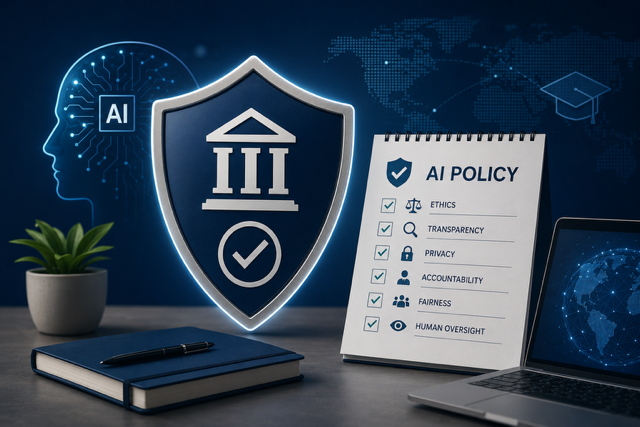
In the future, transparency will be the cornerstone of quality assurance in AI-driven education. Institutions must demonstrate how algorithms make decisions, how data is collected and protected, and how AI tools support rather than bias learning outcomes. Ethical guidelines are becoming a critical part of accreditation standards, emphasizing data privacy, fairness, and accountability. As educational platforms increasingly rely on automation, evaluators will look for clear documentation of AI processes, human oversight protocols, and mechanisms that allow students to understand and challenge decisions made by AI systems. Trust will be built through openness—and institutions that embrace transparency early will gain a competitive edge.
Strengthening Digital Pedagogy and Instructional Quality
Even the most advanced technologies cannot replace high-quality teaching. The future of quality assurance places strong emphasis on digital pedagogy—educators must be proficient in online teaching methods, interactive engagement strategies, and the integration of AI tools that enhance learning. Accreditation agencies are moving beyond traditional faculty credentials to examine evidence of digital competency, instructional design expertise, and ongoing professional development. Institutions that invest in training their faculty to master online and AI-supported instructional methods will deliver stronger learning outcomes and meet evolving standards of excellence.
Ensuring the Integrity of Digital Assessments
Digital and AI-enabled assessments play a central role in online learning, but they also introduce risks related to academic integrity and skill verification. The future of quality assurance demands secure, transparent, and competency-aligned assessment systems. Evaluators will expect institutions to demonstrate how assessments are protected against fraud, how AI proctoring tools are monitored for fairness, and how grading models are validated for reliability. More importantly, assessments must measure real-world competencies rather than simple content recall. Programs that adopt authentic, project-based, or scenario-driven evaluations will be best positioned to earn the trust of employers and accreditors alike.
Data-Driven Quality Improvement as a Core Standard
Quality assurance in the AI era is moving toward continuous, data-driven improvement rather than periodic evaluations. Institutions must show how they use learner data, engagement metrics, and performance indicators to refine their programs. Evaluators are now examining dashboards, analytics systems, and data governance policies as part of their review process. This evolution ensures that educational quality is not static but continuously evolving. Schools that demonstrate a strong feedback loop—where data informs decisions, improvements, and innovations—are emerging as leaders in the digital education landscape.
Global Recognition and Cross-Border Standards
As online learning expands across borders, international quality assurance frameworks are becoming more important. Learners expect that a program taken online in one country will be recognized and respected in another. AI-driven platforms, micro-colleges, and EdTech organizations are accelerating the need for harmonized global standards. Accreditation bodies must collaborate with governments, international agencies, and industry associations to ensure quality benchmarks reflect global expectations. Institutions that pursue digital accreditation aligned with international frameworks will be better positioned to attract global learners and establish credibility in diverse markets.
Action Steps for Institutions Preparing for the Future
Institutions that aim to remain competitive must begin preparing today. They need to invest in digital infrastructure, adopt ethical AI practices, and build strong quality assurance systems that reflect emerging global expectations. The future belongs to providers who take proactive steps rather than waiting for regulatory pressure. Whether an institution is a university, micro-college, bootcamp, or EdTech platform, the opportunity to lead in digital learning is now. Accreditation is no longer just a badge—it is a signal of trust, excellence, and long-term sustainability
Apply for Digital Accreditation
If your organization, platform, micro-college, or bootcamp is ready to embrace the future of quality assurance, begin your accreditation journey today.
👉Apply as an Institution or Organization
References
European Commission. (2022). Digital Education Action Plan (2021–2027). Retrieved from https://education.ec.europa.eu/focus-topics/digital-education/action-plan
OECD. (2022). Unlocking High-Quality Teaching. Retrieved from https://www.oecd.org/en/publications/unlocking-high-quality-teaching
UNESCO. (2023). Guidelines on the Quality of Open, Distance and Digital Education. Retrieved from https://unesco.org
World Bank. (2023). Digital Skills for Education and Development. Retrieved from https://worldbank.org