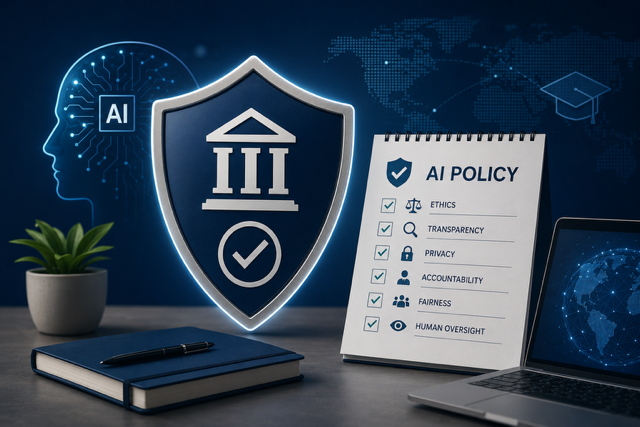

As artificial intelligence becomes embedded in teaching, assessment, and administration, online institutions need clear policies that protect academic integrity, data privacy, and instructional quality. For a global accreditor audience, the key message is simple: institutions do not need to fear AI, but they do need to govern it.
Why AI policy matters now
AI is already influencing lesson planning, student support, grading support, content creation, and research assistance. Without a policy, institutions may allow inconsistent use across departments, creating risks for compliance, quality assurance, and trust. A strong AI policy gives leadership a framework for responsible adoption while keeping the institution aligned with its mission.
Accreditation bodies and quality-focused institutions are increasingly expected to ask how schools manage digital evidence, instructional consistency, and oversight in technology-enhanced learning. That means AI is no longer only an IT issue; it is an academic governance issue.
What the policy should cover
A practical AI policy should address the most important areas first:
- Approved and prohibited uses of AI.
- Expectations for faculty, staff, and students.
- Transparency rules for AI-generated or AI-assisted work.
- Data privacy and protection requirements.
- Academic integrity and assessment boundaries.
- Human review responsibilities.
- Documentation and audit readiness.
Each of these areas helps institutions create a consistent standard across online courses, programs, and departments. The policy should be written in plain language so faculty and students can actually use it, not just file it away.
Faculty expectations
Faculty need clear guidance on where AI can support teaching and where human judgment must remain central. For example, AI may assist with drafting discussion prompts, generating example quiz items, or organizing lesson ideas, but the instructor should still verify accuracy, quality, and alignment with learning outcomes. Institutions should also define whether faculty must disclose AI use in course design, grading support, or communications.
Training is just as important as policy language. A policy without faculty development will not change behavior. Institutions should schedule ongoing professional development so instructors understand both the opportunities and the limits of AI in higher education.
Student use and integrity
Students need to know exactly when AI is allowed, when it is restricted, and when it must be cited or disclosed. If expectations are vague, students may accidentally cross academic integrity lines or use AI in ways that undermine learning. Clear rules reduce confusion and help students build ethical digital habits.
A good policy should distinguish between acceptable support, such as brainstorming or grammar assistance, and disallowed substitution, such as submitting AI-generated work as original thinking. Programs may also want different expectations for lower-level versus advanced coursework, especially in writing, research, or professional practice courses.
Data, privacy, and oversight
AI tools often process sensitive institutional and student data, so privacy must be part of the policy from the beginning. Institutions should know what data each tool collects, where it is stored, and who can access it. Vendor review should include security, retention, and compliance questions before any tool is approved for institutional use.
Oversight should not rely on one office alone. Academic leadership, IT, compliance, and legal or policy reviewers should all have a role in approving tools and monitoring use. That creates a stronger accountability structure and supports accreditation readiness.
A simple implementation path
Institutions can roll out AI policy in four steps:
- Inventory current AI use across the institution.
- Draft a policy for teaching, learning, and operations.
- Train faculty, staff, and students on the new expectations.
- Review the policy each term or academic year.
This approach keeps the process manageable and gives leadership time to adjust as AI tools evolve. It also helps institutions demonstrate continuous improvement, which is essential in quality assurance.
Closing perspective
By 2027, institutions without an AI policy will likely struggle to explain how they ensure quality, consistency, and integrity in digital learning. The institutions that succeed will be those that treat AI as a governed part of their academic ecosystem, not an uncontrolled experiment.
For IACDE and other global quality bodies, the standard should be clear: innovation is welcome, but responsible oversight is non-negotiable.
Ready to begin your accreditation journey? Apply here: https://iacde.org/apply-now/ or contact IACDE at info@iacde.org